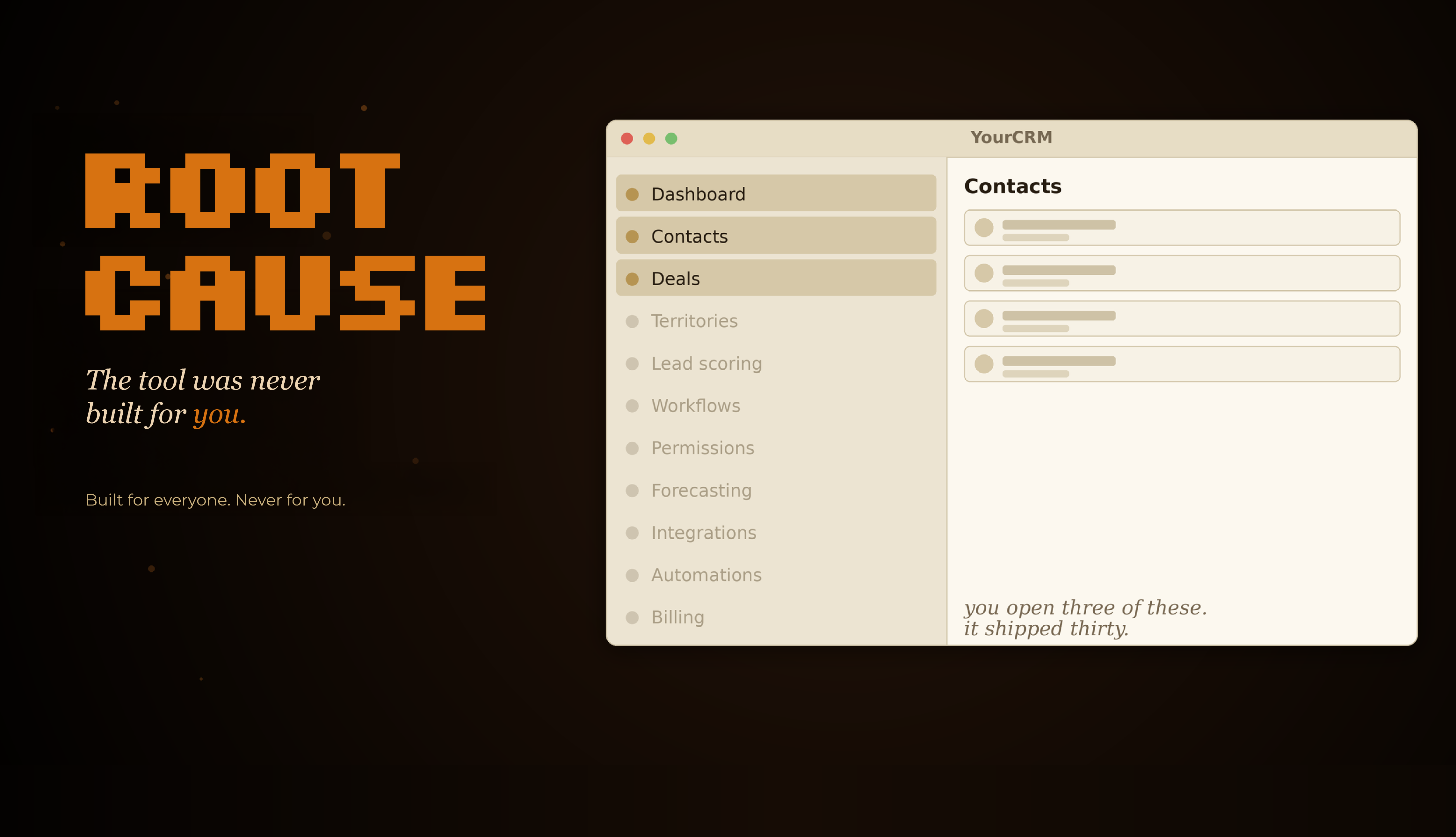
The Tool Was Never Built for You
Almost every tool you use to run your work feels like it was made for someone else. That's because it was.
Author's note
This one is more personal than the last few. It started with my gym membership, of all things, and turned into the thing I now think sits underneath this whole series. I wrote it the way it actually happened to me.
I joined a gym last month.
Within a week I'd downloaded the gym's app, two workout trackers, and started a note on my phone that I was already losing track of. None of them fit. One wanted me to log food I don't measure. One was built for marathon training. One kept asking me to upgrade. So I did what most people do - I went back to the note on my phone, and then I stopped using that too.
Here's the thing I keep noticing now that I look for it: almost every tool a person uses to run something - their classes, their clients, their kitchen, their listings — was built for someone else. Not for them. For an average of them. For a version of their job that fits everybody a little and nobody properly.
And we've all just accepted this.
→ Describe the tool you actually need, and watch it get built → thinkroot.dev
The quiet thing everyone does
Talk to anyone who runs a small business and you'll hear the same story, in different clothes.
The real estate agent who pays for a CRM every month and still tracks her actual deals in a spreadsheet, because the CRM has forty boxes to fill and she needs six.
The tutor who bought the software made for schools and uses maybe a tenth of it, because the rest is for places ten times his size.
The coach with thirty clients across five WhatsApp groups, who tried the proper coaching app and went back to WhatsApp because her clients wouldn't open it.
The restaurant owner with three different systems and a whiteboard, none of which talk to each other, all of which were sold as the answer.
Every one of them did the same quiet thing. They tried the tool. It didn't fit how they actually work. And instead of blaming the tool, they blamed themselves a little, maybe I'm not organized enough, maybe I'm not using it right and went back to the spreadsheet, the notebook, the memory.
The tool failed them. But they carry it like it's their fault.
Why nothing ever fits
It's not that the people who build software are careless. They're solving an impossible problem.
If you're building one tool to sell to a hundred thousand businesses, you can't build it for any single one of them. So you build it for the middle.
You add settings so people can bend it toward themselves a little. You add more features so it can say yes to more customers. And slowly the tool becomes a big, complicated thing that can do almost anything and fits almost no one straight out of the box.
The agent who needs six boxes and the big company that needs sixty are handed the same software. One of them is drowning in it.
This is the part nobody says out loud: the tool was never going to fit you, because it wasn't built for you. It was built for everyone. And "everyone" isn't a person. It doesn't run your business. You do.
What I didn't expect
So, back to the gym.
After I gave up on all the apps, I did something I wouldn't have thought to do a year ago. I described the tracker I actually wanted, not the one a fitness company thinks I need, the one I need - in plain words, like I was explaining it to a friend. Log my workout. Tell me which muscles I keep skipping. Plan my week with rest days. Nothing else. No food logging, no marathon plans, no upgrade screen.
And it got built. For me. Around how I actually train.
I'm not telling you this to talk about the tool I used. I'm telling you because of what it made me realise, which is bigger than any one app:
For my whole life, software was something other people made and I adapted to. The boxes were already decided. The steps were already chosen. My job was to bend myself to fit it, and to feel a bit stupid when I couldn't.
That's the thing that's changing. Not "no code," not "AI" - those are just how it happens. The real change is that the direction flipped. The tool can now be built around the person, instead of the person being squeezed to fit the tool.
The question worth sitting with
So here's what I'd leave you with, whether you run a gym or a clinic or a classroom or a kitchen:
What are you still doing in a spreadsheet because the real tool didn't fit?
What did you quietly give up on, and blame yourself for?
Because I don't think it was you. I think the tool was built for someone else, and you were never that someone. And for the first time, that's a problem you can actually fix - by describing the thing you needed all along, and watching it get built around you instead of the other way round.
The tool was never built for you. It can be now.