I Tested Every Major AI Builder. Here's What Nobody Tells You.
Why I built the same app on Lovable, Bolt, and Replit - and why all three stopped at exactly the same place.
Author's note
| This is the issue I was most asked about after I mentioned it in passing. We actually did this - built the same app on three platforms, documented what happened, and agreed to publish the results regardless of what they were. Some of this is uncomfortable. I'm reporting it anyway because I think you deserve an honest account of what these tools can and can't do. |
|---|
Four weeks. Same app. Three platforms. One person building.
The app: a booking and payment platform for independent fitness trainers. Real-world complexity - user accounts, scheduling, payments, notifications.
Here's what happened.
LOVABLE
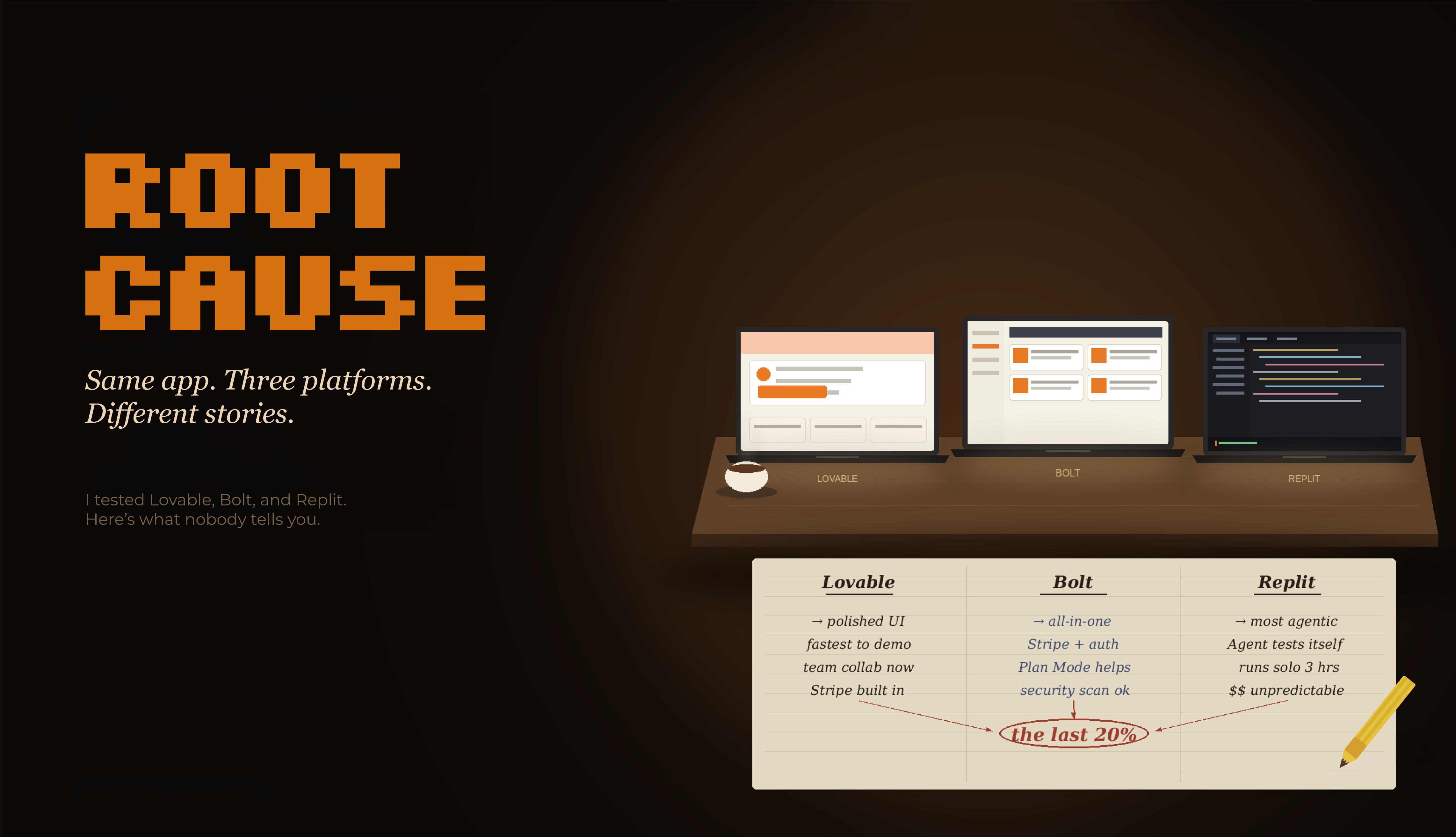
Fastest to a working version. Under sixty minutes. The app looked genuinely good - the kind of polish you'd expect from a designer, not a tool.
Lovable handles almost everything inside the platform. The website goes live with one click. Customers can sign up and log in safely. Their bookings get saved. Payments work through Stripe. The kind of thing that used to need a developer is now a few prompts.
Up to twenty people can work on the same project at once. There's a voice mode where you can speak your changes instead of typing them. The platform has expanded beyond apps — you can build dashboards, analyse data, even make presentation decks inside it.
What it doesn't quite do: handle a thousand customers booking at the same moment, walk you through getting your app accepted into Apple's or Google's store, or be there at 11pm when a payment fails and you need to know why.
BOLT.NEW
Close to Lovable in speed. A bit more opinionated about how things should be built - sometimes that's helpful (cleaner result), sometimes it's a constraint (harder to do things its way).
Bolt does almost everything in one place. You don't need to set up a separate database, separate login system, separate payment processor. It's all built in. Login with Google works out of the box. Stripe is one click for one-time payments or subscriptions. The emails your customers receive - sign-up confirmations, password resets — come with templates you can edit to match your brand.
There's a "Plan Mode" that thinks through your project before writing any code, which helps catch problems early. And the platform flags security issues - like a login that isn't protecting itself properly — and fixes them with a click.
REPLIT
The most interesting of the three. Most ambitious. Where Lovable and Bolt feel like very capable assistants, Replit feels more like a junior developer who works on your project on their own and shows you what they built.
Its AI - they call it Agent - can test the app it built. It opens the app in a browser, clicks the buttons like a real user would, and notices when something looks fine on the surface but doesn't actually work underneath. Then it fixes it. You can let it run on its own for up to three hours on bigger tasks. There's a mobile app now where you can build and ship from your phone.
The trade-off: when the AI does more of the work for you, it also makes more decisions you didn't see it make. So when something does break, figuring out what happened takes longer. Several reviewers also point out that the cost can climb in ways that are hard to predict as your app grows.
Here's the honest summary:
None of these tools is the wrong choice. All three are extraordinary. Whatever you've been hearing about how fast and capable these things are - it's true. The demos are real.
But here's the specific thing none of them fully covers - and this is an observation, not a criticism:
They get you most of the way from "I have an idea" to "this works in a browser for one person." What they don't fully get you to is "this works for a thousand users, survives a Play Store review, handles concurrent payments without breaking, and doesn't require me to be awake monitoring it at 2am."
That gap is roughly the last twenty percent of what it takes to ship a real product. The first eighty percent these tools handle remarkably well.
What lives in that last twenty percent: behaviour when a lot of real people use your app at the same time. Getting accepted into Apple's App Store or Google's Play Store - the actual back-and-forth with their review teams. The legal and compliance side if your app touches health data, financial data, or anything sensitive under Indian regulations. Knowing what's going wrong in real time when a paying customer hits a problem. And the bill - what your costs look like when you're not playing around any more, you're actually running a business.
There's also one thing that doesn't fit neatly anywhere: the more the AI builds for you, the harder it can be to understand what it built. That trade-off doesn't disappear. It just moves further along.
I want to say one more thing about this.
The tools are improving. Fast. The gap I'm describing is shrinking with every release.
They're also not turning into the same tool. They're each picking a lane. Lovable is the polished, design-forward web app builder for people who care about how things look and who want to work with a team. Bolt is the all-in-one platform for people who want to sell something online without piecing together five different services. Replit is the platform for people who want the AI to do more of the work itself, and are okay trading some visibility for that.
Which one is right for you depends on what you're building and how much of the building you actually want to be doing yourself.
The question isn't whether these tools will eventually close the rest of the gap. They will. The question is what you do between now and then - if you have something you want to ship.
Next issue, I want to tell you about the apps that never shipped. Not data. Real stories. Three founders who hit The Wall and stopped. Because I think their apps deserved to exist, and I think you should know their names.
| Next issue → The App Graveyard. Three founders. Three apps that deserved to exist. And the specific moment each one stopped. |
|---|