The Steam Engine on a Horse Carriage: Why Developer Metrics Are Broken
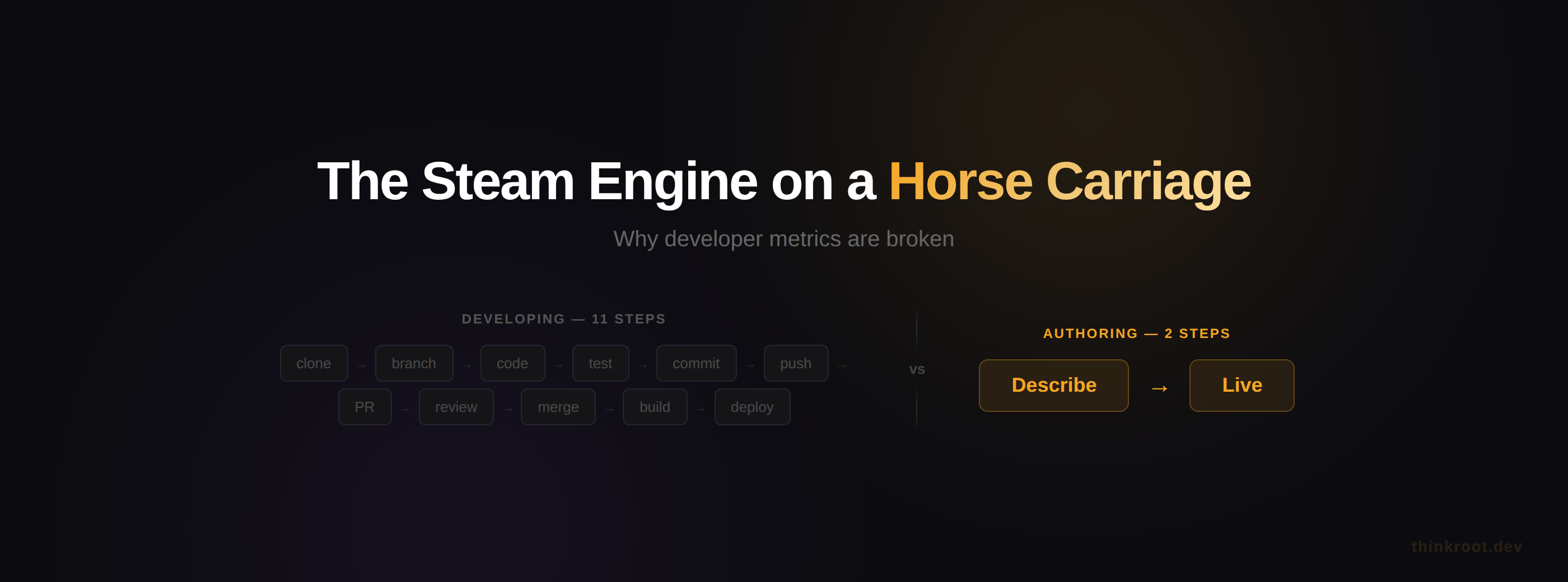
Measuring the AI revolution with PR cycle times and merge rates is a steam engine strapped to a horse carriage. The real shift isn't faster developing — it's authoring.
Every engineering leader in the world is chasing the same thing right now: 10x productivity through AI.
But look at how we're measuring this "revolution." PR cycle times. Merge conflicts. Build success rates. Deployment velocity.
That's a steam engine strapped to a horse carriage on a muddy road. You can't accelerate into the future using the infrastructure of the past.
The bottleneck moved. Nobody noticed.
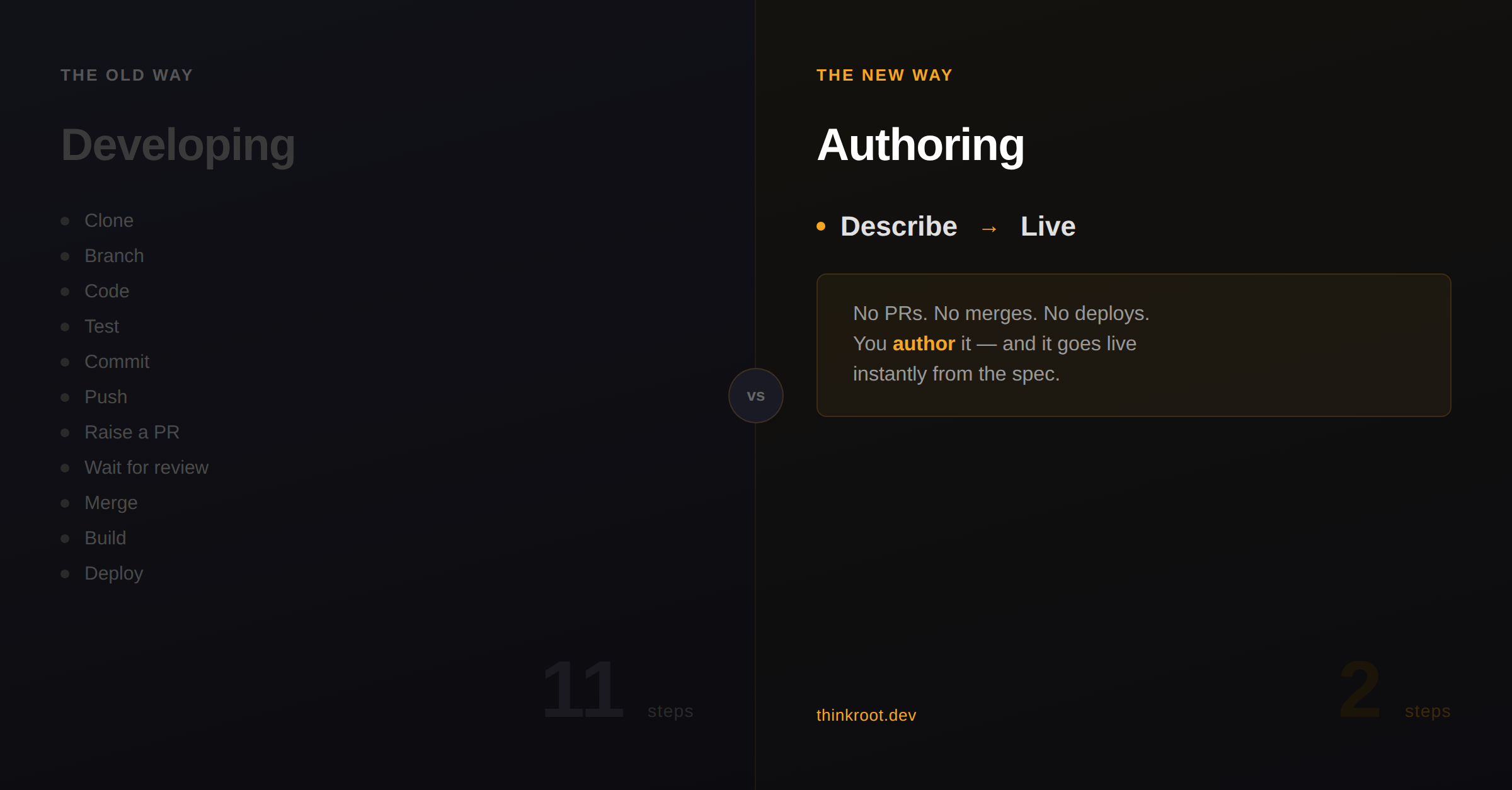
For decades, the software lifecycle has been the same loop: clone, branch, code, test, commit, push, raise a PR, wait for review, merge, build, deploy.
Now we've added AI coding assistants into this loop. And everyone's celebrating.
But here's what actually happened: the AI writes code faster, and your developers still spend hours navigating merge conflicts, managing dependencies, and waiting on CI/CD pipelines. You didn't transform anything. You just created a faster bottleneck.
The real shift: from developing to authoring
This is the idea behind Thinkroot. The entire traditional development loop is obsolete. Not improvable. Obsolete.
On Thinkroot, you don't develop software. You author it. You express the intent, the business logic, the flow through pure specification, not code.
Source control overhead disappears. No checkout, no check-in, no cloning, no PRs, no merges. Building and deploying become invisible. Your application goes live directly from the authoring environment the moment it's ready.
When you remove every layer of friction between thought and execution, software development stops being a manufacturing process. It becomes a creative act.
This isn't theoretical. Here's the proof.
These are full-stack, production-ready applications. Each one was authored from scratch on Thinkroot - no code, no deployment pipeline and went live in under an hour.
A dynamic survey platform - the kind of data-collection tool companies pay development agencies lakhs to build. Authored and live in one sitting. → Try it: survey-app-pdodf.thinkroot.app
A DSA question generator for interviews - complex logic, interactive UI, the kind of tool that would take a dev team weeks. Authored and live in one sitting. → Try it: dsa-question-generator-rezhj.thinkroot.app
A sprint and project management tool - Jira-like functionality, authored from a spec. → Try it: scrum-management-tool-lffqd.thinkroot.app
No developer wrote a line of code. No PR was raised. No build was triggered. No deploy command was run.
Each one went from idea to live application in under an hour.
The old metrics are measuring the wrong thing
If your engineering dashboard still tracks PR cycle time, you're measuring how fast your team navigates an obstacle course you built for them. Remove the obstacle course and the metric becomes meaningless.
The new question isn't "how fast can we ship code." It's "how fast can we go from intent to live software."
On Thinkroot, the answer is: one sitting.
No PRs. No merge conflicts. You don't develop apps — you author them.
→ See it yourself: thinkroot.dev